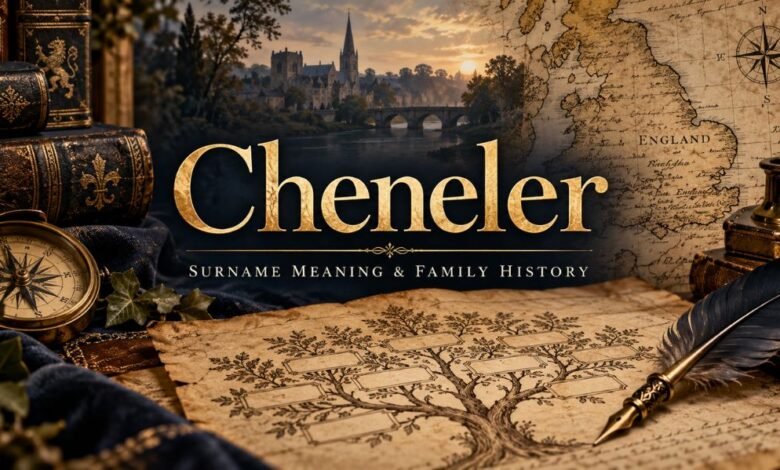
Cheneler: The Remarkable Story, Meaning, and History Behind a Rare English Surname
Exploring the origin, historical meaning, spelling variations, family history, and lasting identity connected with the Cheneler name

The Cheneler surname is an uncommon English family name with a history connected to language, occupations, and everyday life in medieval Britain. Unlike highly familiar surnames such as Smith, Taylor, or Baker, Cheneler is rarely encountered today. That rarity is one reason people searching for the name may want to understand its origin, original meaning, and how it developed over generations.
Historical surname research connects Cheneler with the Middle English word chaneler. The term was associated with a chanel, meaning a channel, conduit, gutter, or drain. Researchers therefore believe the surname may have originally described someone whose work involved channels or drainage systems.
This explanation places Cheneler among the many English family names that developed from a person’s occupation, environment, or social role. However, centuries of spelling changes mean tracing one Cheneler family line requires careful examination of historical records rather than relying on modern spelling alone.
What Does Cheneler Mean?
The most widely supported explanation of the Cheneler meaning comes from Middle English. The historical word chaneler is considered an agent form of chanel, a word associated with a channel, conduit, gutter, or drain.
In practical terms, the name may have identified someone who dug, maintained, repaired, or otherwise worked on channels and drainage systems. Such work would have been important in settlements, agricultural areas, roads, estates, and places where water needed to be controlled.
It is best to describe this explanation as probable rather than absolute. Medieval surnames did not always develop according to one simple rule, and the same family name could sometimes develop in different places for slightly different reasons.
Was Cheneler Originally an Occupational Surname?
Evidence strongly suggests that Cheneler may be an occupational or locative surname.
Occupational surnames described an individual’s work. Familiar examples include Baker, Carpenter, Miller, and Fisher. Cheneler appears to belong broadly to the same tradition, although the occupation behind it was much less common.
A locative interpretation is also possible because people could be identified according to an important geographical feature near their home or workplace.
Why Channels Were Important in Earlier Communities
Before modern underground drainage and large municipal water systems, channels, ditches, conduits, and gutters mattered in practice. They could help manage water, drain land, protect roads, support farming, or carry unwanted water away from populated areas.
Someone responsible for constructing or maintaining such features could therefore have developed a descriptive name connected with that work.
The Historical Origin of the Cheneler Surname
The Cheneler surname origin is associated primarily with England and the development of English surnames during the medieval and early modern periods.
Family names became increasingly important as communities grew and officials needed clearer ways to distinguish people who shared the same first name. A person’s profession, hometown, parent, physical characteristic, or surrounding landscape could become part of his identification.
Over generations, these descriptions gradually became hereditary surnames.
Historical surname references record related spellings long before the standardized modern form became established. One documented example is Robert Channeller, recorded in Wiltshire in 1440. Other historical records include forms such as Chaneler, Chanler, and Chenerler.
These records do not prove that every person carrying a related spelling belonged to one continuous family line. They do, however, demonstrate the long historical presence of closely associated forms of the name.
Why Did the Spelling of Cheneler Change?
Spelling was far less standardized in previous centuries than it is today.
A parish clerk, census official, priest, court employee, or registrar might write a surname according to how it sounded. Regional accents could also influence the spelling that appeared in official documents.
For this reason, anyone researching Cheneler family history should not assume every ancestor used the exact spelling “Cheneler.”
Historical Spellings Related to Cheneler
Documented or closely related historical forms include:
Channeller, Chaneler, Chanler, Chenerler, Channell, and Cheneler.
Not every occurrence of these names necessarily represents the same family. Nevertheless, checking spelling variations is an important part of serious genealogical research.
Why Spelling Variations Matter in Genealogy
Searching only for “Cheneler” could cause a researcher to miss valuable birth, marriage, burial, census, property, or parish records.
A historical ancestor recorded under one spelling might appear under another form several decades later. Comparing names with locations, relatives, occupations, and dates can help determine whether two records refer to the same family.
How Rare Is the Cheneler Name?
Cheneler is a rare surname, especially compared with common British family names.
Historical surname research indicates a much smaller population of Cheneler families than families carrying widely established English surnames. Modern surname-distribution databases also associate the name’s strongest presence with England, although people with the surname can be found outside Britain as well.
Its rarity makes the name especially interesting for genealogical research. A less common surname can sometimes make individuals easier to identify in historical documents, although unusual spellings can create additional difficulties.
Cheneler Family History and Migration
Like many British families, people carrying the Cheneler name eventually appeared in records outside England.
Genealogical databases contain Cheneler records connected with both the United Kingdom and the United States. Migration, marriage, employment, military service, and economic opportunity all contributed to the international movement of British families over time.
However, sharing the surname alone does not prove that two modern Cheneler families share a recent ancestor. Genealogical connections should always be established through documentary evidence.
How to Research Cheneler Genealogy
Anyone investigating Cheneler genealogy should begin with information that can be verified within the family.
Start with parents, grandparents, and great-grandparents before attempting to connect the family to medieval records.
Useful documents may include birth certificates, marriage certificates, death registrations, census returns, parish registers, military records, immigration records, wills, probate documents, newspaper notices, and cemetery records.
Search Beyond the Exact Cheneler Spelling
One of the most important strategies is using alternative spellings.
Researchers should consider whether a handwritten record was transcribed incorrectly or whether an official recorded the surname phonetically.
The combination of name, location, approximate age, occupation, spouse, and children usually provides stronger evidence than the surname by itself.
Build the Family Tree One Generation at a Time
It can be tempting to connect a modern family directly to an early historical bearer with a similar surname. That approach can produce inaccurate family trees.
A stronger method is to establish each generation separately and confirm the connection with reliable documents. This makes the resulting Cheneler family history far more trustworthy.
The Modern Identity of the Cheneler Name
Today, Cheneler survives as a distinctive family name with strong English historical associations.
The meaning behind the surname offers an interesting reminder that many modern identities began as ordinary occupations and landscape features. What may once have been a practical description eventually became a hereditary family name preserved across centuries.
Its rarity also gives the surname a distinctive character. For modern families, understanding its origin can provide historical context without assuming that every Cheneler shares the same ancestry.
Frequently Asked Questions About Cheneler
What does the surname Cheneler mean?
Cheneler likely derives from the Middle English word chaneler, meaning someone connected with a channel, conduit, gutter, or drain. It may originally have described someone who worked on or maintained channels and drainage systems.
Where does the Cheneler surname come from?
The surname is primarily associated with England and has roots in Middle English naming traditions.
Is Cheneler a common surname?
No. Cheneler is considered a relatively rare family name compared with more widespread English surnames.
Are there different spellings of Cheneler?
Yes. Historical records contain related forms such as Channeller, Chaneler, Chanler, and Chenerler. Researchers should check alternative spellings when studying family history.
Is everyone named Cheneler related?
Not necessarily. People can share a surname without having a recent common ancestor. Genealogical records must establish a genuine family relationship.
Conclusion
The Cheneler surname offers a fascinating example of how language, work, geography, and family identity can connect across generations. Its probable roots in the Middle English chaneler link the name with channels, conduits, gutters, drains, and the people who may once have worked around them.
Historical spelling variations show why surname research requires more than searching for a name’s modern form. Records such as parish registers, census documents, civil registrations, wills, and migration records can reveal how individual Cheneler families developed over time.
Although Cheneler remains a rare English surname, its documented history reaches back centuries. For anyone carrying the name today, exploring Cheneler family history can offer a meaningful window into changing English language, medieval occupations, migration, and the long process through which family names became part of personal identity.