Step Pe: The Powerful Framework Transforming Inclusive Physical Education
Discover how the STEP model helps teachers adapt sports activities, boost student participation, and create engaging physical education lessons for students of all abilities.

Introduction
Physical education is essential for developing physical fitness, coordination, confidence, and teamwork among students. However, traditional sports activities do not always meet every learner’s needs. Differences in physical abilities, experience, confidence, and mobility can make participation challenging. Step Pe provides a practical approach to overcoming these challenges through flexible teaching methods.
The framework allows educators to modify activities without losing their original learning objectives. Instead of expecting every student to complete an activity the same way, teachers can adjust specific elements to make participation more accessible and meaningful.
This article explains Step Pe, its four core components, practical classroom applications, key benefits, and strategies for creating more inclusive physical education experiences.
What Is Step Pe?
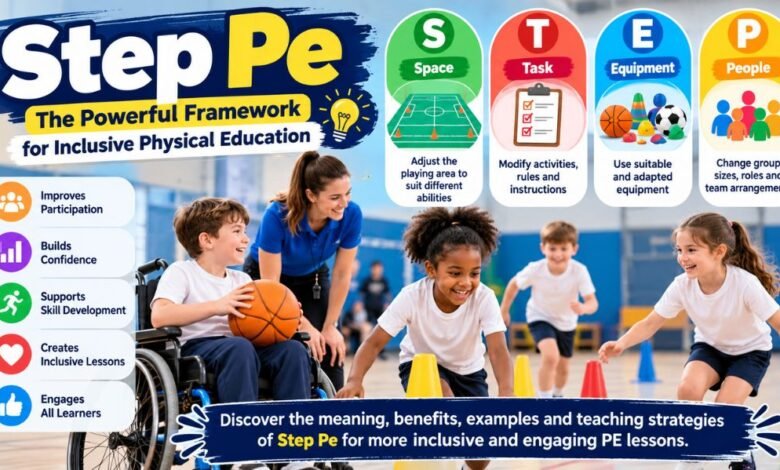
Step Pe refers to the STEP framework in physical education, an approach that adapts sports, games, and movement activities to different participants’ needs.
STEP stands for:
- S – Space: Adjusting the physical environment.
- T – Task: Modifying activities and instructions.
- E – Equipment: Changing the tools used during activities.
- P – People: Adjusting participant numbers, roles, or group arrangements.
The Youth Sport Trust developed this framework, and it has been used in inclusive sports education for many years.
Its fundamental purpose is to make physical activities accessible while maintaining appropriate challenge levels.
Understanding the Four Components of Step PE
Each component gives teachers different opportunities to improve participation and learning.
1. Space: Creating Suitable Activity Environments
Space refers to the area where physical activities take place. Teachers can modify the size, boundaries, layout, or surface of an activity area.
For example, students learning basic passing techniques might benefit from shorter distances. More experienced students could work with smaller playing areas that require quicker decisions.
Why Space Matters
Appropriate space adjustments can improve movement opportunities, help manage challenges, and make activities more accessible.
Teachers should consider mobility requirements, available facilities, and the skills being taught before changing the environment.
2. Task: Adapting Activities to Individual Abilities
Task modification involves changing how an activity is performed.
Teachers might simplify instructions, introduce alternative movements, change game rules, or divide complex skills into smaller stages.
For instance, beginners learning basketball could practice controlled passing before attempting competitive matches.
Supporting Skill Development
Task adjustments help students work towards achievable goals without removing meaningful challenges.
As learners gain confidence, teachers can gradually introduce more demanding activities.
3. Equipment: Choosing Appropriate Sports Resources
Equipment can significantly influence a student’s ability to participate.
Using lighter balls, larger targets, lower nets, or modified sporting equipment may improve accessibility.
For example, a student developing catching skills might start with a larger, softer ball before moving to a smaller one.
Making Equipment More Inclusive
Equipment selection should reflect participants’ abilities, safety requirements, and learning objectives.
The aim isn’t necessarily to make every activity easier, but to provide suitable opportunities for progress.
4. People: Organizing Participants Effectively
The People component focuses on how students interact during activities.
Teachers can adjust group sizes, partnerships, team arrangements, and participant roles.
For example, smaller teams may give each student more opportunities to handle a ball during a football activity.
Encouraging Cooperation and Confidence
Thoughtful grouping can support teamwork, communication, and participation.
However, teachers should avoid arrangements that unnecessarily isolate students or limit their opportunities to develop new skills.
Why Step PE Is Important in Modern Education
Physical education classes often include learners with different strengths, experiences, and support needs.
A single activity format may not challenge everyone appropriately.
Inclusive physical education recognizes these differences and encourages meaningful participation.
Step PEPE gives teachers a structured way to adjust activities rather than exclude students.
It is particularly useful when supporting learners with special educational needs and disabilities, although its principles apply to all students.
How Teachers Can Apply Step PE Successfully
Identify the Learning Objective
Teachers should first determine what students are expected to learn.
The objective might involve improving balance, controlling a ball, developing coordination, or practicing teamwork.
Observe Student Participation
Educators can then identify difficulties affecting individual learners.
These might include unsuitable equipment, overly complex tasks, limited movement space, or unbalanced teams.
Make Appropriate Adjustments
Teachers should modify the relevant STEP component while preserving the main educational objective.
Changing one element at a time can also help identify which adjustment improves the activity.
Review Student Progress
After making adjustments, teachers should observe whether students demonstrate improved participation, independence, and skill development.
Further changes may be necessary as abilities develop.
Practical Examples of Step PE Activities
Football Training
Teachers can modify football activities by reducing team sizes, changing playing areas, or allowing extra time for ball control.
These adjustments provide different levels of challenge while maintaining the focus on football skills.
Basketball Lessons
Teachers can lower shooting targets, introduce softer balls, or modify passing distances.
Such changes may help beginners practice coordination and improve their understanding of the activity.
Athletics and Movement Games
Running, throwing, and movement exercises can be adapted through alternative distances, equipment, and movement options.
The goal is to support meaningful participation without overlooking individual safety requirements.
Benefits of Using Step PE
The framework offers several practical advantages:
- Improved accessibility: Activities can accommodate different physical abilities.
- Greater participation: Students receive more opportunities to practice important skills.
- Flexible learning: Teachers can adjust challenges according to progress.
- Skill development: Appropriate modifications support gradual improvement.
- Teamwork: Thoughtful group arrangements encourage cooperation.
These benefits depend on effective lesson planning, observation, and appropriate teaching decisions.
Common Mistakes Teachers Should Avoid
One common mistake is changing activities without understanding why students are struggling.
Another is assuming that inclusive teaching always means reducing difficulty. Advanced learners also need suitable challenges.
Teachers should avoid changing too many elements at once when a smaller adjustment would work.
Importantly, the framework does not replace safeguarding procedures, specialist guidance, individual support plans, or proper risk assessments.
Conclusion
Step Pe offers a valuable framework for improving physical education through thoughtful activity adaptations. Its four components—Space, Task, Equipment, and People—offer practical options to support learners with different abilities and experiences.
By identifying individual needs, adjusting relevant activity elements, and evaluating progress, teachers can create more accessible and engaging lessons.
The framework’s greatest strength lies in its flexibility. When applied effectively, it lets students work toward meaningful learning goals while receiving the right level of support and challenge.
(FAQs)
1. What does Step Pe stand for?
STEP stands for Space, Task, Equipment, and People. These four elements can be modified to make physical education activities more accessible and appropriately challenging.
2. Why is Step Pe important in schools?
It helps teachers accommodate different student abilities, support participation, and create more inclusive physical education experiences.
3. Can Step Pe support students with disabilities?
Yes. The framework helps teachers adapt activities for students with disabilities, with appropriate individual support and safety arrangements.
4. Is Step Pe suitable for primary and secondary schools?
Yes. Teachers can apply the framework across different age groups by adjusting activities according to students’ learning objectives and abilities.
5. Does Step Pe require expensive equipment?
No. Many adaptations involve adjusting playing areas, rules, group sizes, or existing equipment rather than purchasing additional resources.