Drums Timpani: The Powerful Orchestral Drums That Give Music Depth and Drama
Discover how these tunable kettledrums work, why composers rely on them, and what makes their sound distinctive.

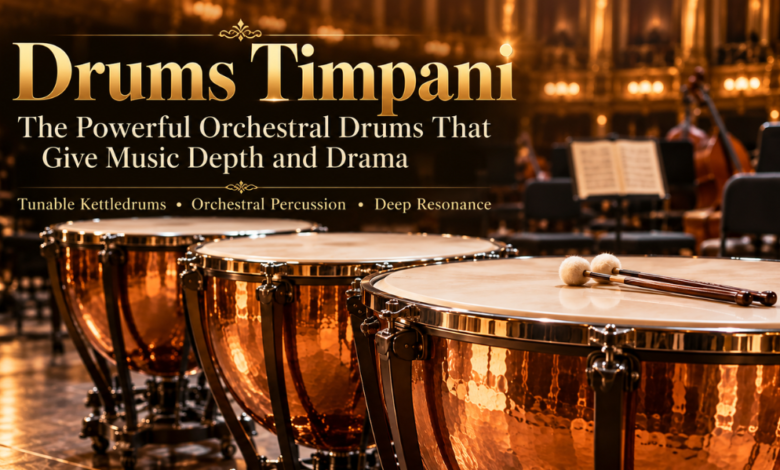
A single timpani stroke can transform a performance. Its resonant note can announce drama, reinforce a phrase, or create tension before the ensemble enters. Unlike most familiar drums, timpani produce recognizable pitches, letting them support both rhythm and harmony.
Often called kettledrums, these instruments are found in symphony orchestras, concert bands, and percussion ensembles. Their design and technique explain their importance to orchestral music.
What Are Drums Timpani?
Timpani are large, bowl-shaped percussion instruments with a single stretched drumhead. Mallets produce a rich, sustained tone. Timpani is plural; one drum is a timpano.
Their defining characteristic is adjustable pitch. By changing the drumhead’s tension, the player can tune each instrument to a specific musical note. A timpanist commonly performs on a set of two to four drums of different sizes, although larger arrangements are possible.
Why Are They Called Kettledrums?
The nickname comes from their rounded, kettle-like shells. These bowls influence resonance and help produce pitches that distinguish timpani from other drums.
The History of Timpani
Early kettledrums accompanied trumpets in military processions and royal ceremonies before becoming established in European music.
By the seventeenth century, timpani had entered orchestral music. Players generally used paired drums tuned to important notes, often the tonic and dominant. Changing those pitches during performance was difficult because the heads had to be adjusted manually.
Later mechanical developments made retuning faster. Composers, including Beethoven, expanded the instrument’s musical role, while improved pedal mechanisms eventually made frequent pitch changes practical.
How Timpani Are Built
Modern instruments combine acoustics with mechanical engineering. Each component affects their sound.
Main Parts of a Timpani
- Kettle: The resonating bowl, commonly made of copper or fiberglass.
- Drumhead: A calfskin or synthetic membrane stretched across the opening.
- Hoop and tension rods: Hardware that secures the head and helps distribute tension.
- Foot pedal: A mechanism that raises or lowers the pitch on modern pedal timpani.
- Tuning indicator: A guide showing approximately where selected notes fall.
How Does the Pedal Change Pitch?
Pressing the pedal generally increases head tension, raising the pitch. Releasing it reduces tension and lowers the pitch. Because the adjustment is continuous, a timpanist can also create a glissando, a sliding movement between pitches, when the music calls for it.
A tuning gauge is useful, but musicians still check pitch by ear. This matters especially during live performances. The drum must also be tuned evenly around its circumference to achieve a clear, consistent tone.
Timpani Sizes and Sound
Larger drums generally cover lower notes, while smaller drums cover higher ones. Common orchestral sizes include approximately 23, 26, 29, and 32 inches, measured across the head. Ranges vary by manufacturer.
The tone may be warm, thunderous, or sharply articulated. Its character depends on pitch, head material, mallet choice, striking position, and the player’s touch.
Timpani Versus Ordinary Drums
A snare drum emphasizes crisp rhythmic attacks, while bass drums deliver broad low-frequency impact. A timpano also creates rhythm, but its distinct pitch lets it reinforce a chord’s foundation or interact with bass instruments. This makes timpani a bridge between the percussion section and the orchestra’s harmonic structure.
How to Play Timpani
Playing well requires more than striking the head loudly. A timpanist must control each note’s quality while listening closely to the ensemble.
Essential Playing Techniques
Mallet selection: Felt-covered mallets are common. Softer heads generally produce a rounder attack, while firmer mallets give greater definition.
Striking position: Players usually strike near the edge, not directly on the rim or in the center, to encourage a clear, pitched tone.
Rolls: Rapid alternating strokes create a sustained, shimmering sound. Smoothness depends on timing, stick control, and the drum’s response.
Dampening: Lightly touch the head to stop unwanted ringing, keeping changing harmonies clean.
A Simple Practice Routine
Begin by matching a reference note and checking that the drum is in tune. Practice relaxed, evenly spaced single strokes, then alternate hands at a steady tempo. Add controlled rolls and deliberate dampening before attempting quick pedal changes. Record exercises to hear uneven attacks or lingering resonance.
Why Timpani Matter in an Orchestra
Timpani can underline a powerful climax, establish a steady pulse, or introduce suspense with a quiet roll. In classical scores, their notes frequently support important harmonic relationships. Modern composers also exploit quick retuning and unusual effects for added color.
Their sound carries through the ensemble without constant playing. A thoughtfully placed note may have more impact than an extended passage, which is why musical judgment matters as much as technique.
Choosing and Caring for Timpani
Schools and ensembles should assess pitch range, pedal reliability, sound quality, room space, and budget before purchasing. Matching drums may feel consistent, but condition matters more than appearance.
Regular care includes keeping the heads clean, checking that tension is balanced, protecting the bowls from damage, and avoiding unnecessary extremes of temperature or humidity. Follow the manufacturer’s instructions for any adjustments to a pedal mechanism.
Conclusion
Drums timpani combine the physical force of percussion with the musical flexibility of a pitched instrument. Their distinctive bowls, adjustable heads, and responsive mallets allow performers to shape rhythm, harmony, and emotion. For listeners, recognizing their sound adds depth to orchestral music; for aspiring players, good tuning and controlled technique are the foundations of expressive performance.
Frequently Asked Questions
1. Are timpani tuned or untuned percussion?
Timpani are tuned percussion. Each drum can produce specific notes within its available pitch range.
2. How many timpani are used in an orchestra?
Two to four are common, but the number depends on the score, ensemble, and available instruments.
3. What are timpani sticks called?
They are usually called timpani mallets, often made with felt-covered heads of different firmness.
4. Can timpani play melodies?
Yes. Because they produce identifiable notes, timpani can play melodic passages, although their pitch range and tuning needs shape what is practical.
5. Are timpani difficult to learn?
Beginners can learn basic strokes relatively quickly. Reliable tuning, smooth rolls, precise dampening, and confident ensemble playing require sustained practice.