Dentiloquent: The Fascinating Meaning, Origin, and Power of Speaking Through the Teeth
Discover the surprising history of this rare English word, its connection to human communication, and how to use it correctly.

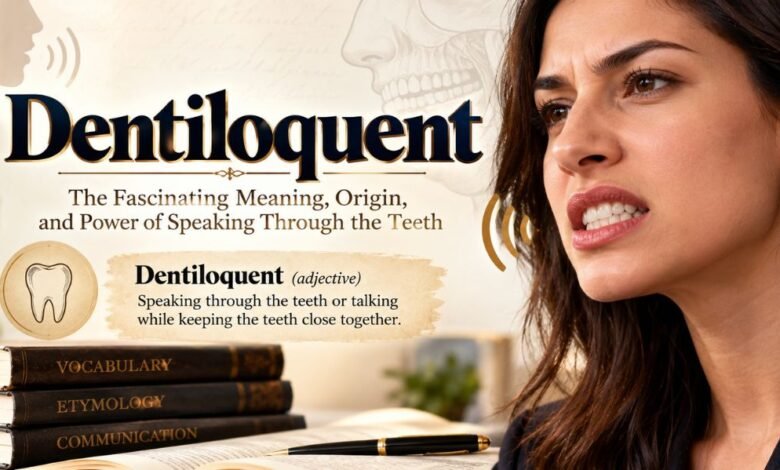
Dentiloquent is an unusual English word for speaking through the teeth, often while keeping the jaw nearly closed. Although rarely used in everyday conversation, the term offers an interesting way to describe a distinctive speech style.
Language contains thousands of expressions that capture small details of human behavior. Some describe emotions, while others explain physical actions. Dentiloquent belongs to the second category, referring primarily to how someone produces spoken words.
The term can be particularly useful in literature, character descriptions, and discussions about unusual vocabulary. Understanding its meaning also reveals how closely language connects with facial movements and expression.
This article explores the meaning, history, pronunciation, practical examples, and linguistic significance of Dentiloquent, explaining why this uncommon word remains interesting today.
What Does Dentiloquent Mean?
Dentiloquent means speaking through the teeth or talking while keeping the teeth close together. It functions as a descriptive adjective rather than the name of a particular language or medical condition.
Imagine someone delivering a sentence without opening their mouth very widely. Their jaw stays relatively still, and the words come out through narrowly separated teeth. This speaking style is called dentiloquent.
The word does not necessarily imply anger or frustration. Although people sometimes speak through clenched teeth when upset, the same physical behavior may occur during theatrical performances or deliberate character portrayals.
Dentiloquent Meaning in Simple English
In simple terms, Dentiloquent means talking through your teeth.
It describes the physical manner of speaking, not the subject of a conversation.
For example, a character might respond in a dentiloquent voice while attempting to conceal irritation during a difficult conversation.
Is Dentiloquent a Real English Word?
Dentiloquent is a documented but exceptionally uncommon English word. Collins English Dictionary includes it in its New Word Suggestion database, where it is identified as a term being monitored for evidence of usage.
Its relative obscurity explains why many readers may not recognize it immediately. The related noun, dentiloquy, is also documented in historical dictionaries.
The Origin and Etymology of Dentiloquent
The meaning of Dentiloquent becomes easier to understand when its linguistic components are examined.
The term draws on two Latin elements: dens, meaning tooth, and loqui, meaning to speak.
Together, these elements describe speech produced through or between the teeth.
Connection to Latin Vocabulary
Many familiar English expressions share similar linguistic roots.
The Latin word dens, whose genitive form is dentis, appears in dental terminology. Words associated with dentistry, dentures, and dentition all reflect this connection to teeth.
Meanwhile, loqui contributes to English expressions connected with speech, including eloquence, colloquy, and loquacious.
Dentiloquent combines these familiar linguistic ideas into a much less familiar descriptive expression.
How the Word Developed
The related noun dentiloquy has a documented history extending back several centuries. Historical English dictionaries describe it as speaking through the teeth or with the teeth closed.
Dentiloquent belongs to this same vocabulary family, although it never became a widely used conversational adjective.
Why Rare Words Survive
Uncommon words sometimes remain useful because they express a specific idea with unusual precision.
Instead of using an entire phrase to describe a character speaking through nearly closed teeth, a writer can occasionally choose Dentiloquent.
However, unfamiliar terminology works best when the surrounding sentence makes its meaning clear.
How Dentiloquent Speech Works
Ordinary speech involves coordinated movement of the tongue, lips, jaw, vocal folds, and other parts of the vocal tract.
When someone speaks with the teeth close together, jaw movement becomes more restricted. The speaker may compensate by changing lip and tongue movement.
This can alter how clearly particular sounds are produced.
The Role of Teeth in Speaking
Teeth are already important to ordinary speech.
For example, certain English consonants involve contact between the tongue and teeth, while others involve the lower lip and upper teeth.
However, dentiloquence does not simply mean producing sounds that involve teeth. It describes a broader manner of speaking, with the teeth kept close together.
Emotional Expression Through Speech
People may sometimes adopt this speaking style when attempting to control their outward reactions.
A tense conversation, suppressed frustration, or an effort to remain discreet can provide the context for such speech.
Nevertheless, the speaking pattern alone cannot reliably establish someone’s emotional state.
Dentiloquent Speech in Acting
Actors can use restricted jaw movement to communicate tension or create a memorable fictional character.
A carefully delivered line through nearly closed teeth may suggest restraint.
The interpretation depends on facial expression, dialogue, performance, and context.
Dentiloquent Examples in Everyday English
Understanding a rare word is easier when it appears in complete sentences.
Consider these examples:
“The detective gave a dentiloquent reply, barely moving his jaw.”
“His dentiloquent warning made the conversation feel unusually tense.”
“The actor adopted a dentiloquent speaking style for the dramatic scene.”
“She answered in a dentiloquent manner, keeping her teeth almost closed.”
Each example describes the way a person speaks rather than making a definite claim about their personality.
When Should You Use Dentiloquent?
The word is most appropriate when describing an unusual manner of speech in fiction, literary analysis, or creative writing.
It may also appear in discussions of rare English vocabulary.
For ordinary communication, the phrase “speaking through clenched teeth” is usually easier to understand immediately.
Dentiloquent vs. Other Speech-Related Words
Several English expressions describe distinctive speaking patterns, but their meanings differ.
Dentiloquent vs. Muttering
Muttering generally describes speaking quietly or indistinctly. A person may mutter with their mouth open or closed.
Dentiloquent specifically concerns speaking through the teeth.
Dentiloquent vs. Whispering
Whispering refers to producing speech without normal vocal-fold vibration.
Dentiloquent speech, by contrast, is defined by tooth position and a restricted mouth opening.
Someone could whisper through nearly closed teeth, but the terms describe different characteristics.
Dentiloquent vs. Ventriloquism
Ventriloquism is a performance technique associated with producing speech while minimizing visible mouth movements.
Although the two may involve restricted mouth movement, dentiloquent speech is not synonymous with ventriloquism.
Why Dentiloquent Matters in Literature and Communication
Rare descriptive words can make writing more expressive when used carefully.
Dentiloquent gives an author a compact way to portray a particular physical behavior during dialogue.
A writer might use it to suggest tension between characters or to describe an unusual speaking habit without lengthy explanation.
However, clarity should remain the priority.
Using Rare Vocabulary Naturally
An unfamiliar word should contribute something meaningful to a sentence.
Repeatedly inserting Dentiloquent merely to sound sophisticated can make otherwise simple writing unnecessarily difficult.
The strongest approach is to use it sparingly and provide enough context for readers to understand the description.
Understanding the Limitations
Dentiloquent is not a clinical diagnosis, a psychological classification, or an established personality type.
It does not prove that someone is angry, dishonest, anxious, or attempting to hide information.
Its central meaning remains physical and descriptive: speaking through the teeth.
Conclusion
Dentiloquent is a rare but interesting English adjective that describes speaking through or between the teeth. Its Latin connections reveal how the vocabulary of speech and anatomy can combine to create highly specific expressions.
Although the term is unlikely to replace everyday phrases, it has value in literature, vocabulary study, and expressive character descriptions.
Understanding Dentiloquent also highlights an important principle of communication: how words are delivered can contribute to their meaning, but interpretation always depends on context.
Frequently Asked Questions About Dentiloquent
1. What is the meaning of Dentiloquent?
Dentiloquent describes someone speaking through the teeth, usually while keeping the jaw relatively closed. It is an uncommon adjective associated with a particular manner of speaking.
2. What is the origin of the word Dentiloquent?
The word comes from Latin roots meaning tooth and speak. The related noun dentiloquy has appeared in historical English dictionaries for centuries.
3. Is Dentiloquent commonly used in modern English?
No. Dentiloquent is exceptionally rare in contemporary conversation and writing. Most people use simpler descriptions, such as speaking through clenched teeth.
4. Does Dentiloquent always mean someone is angry?
No. Although speaking through clenched teeth can accompany frustration, dentiloquence describes a physical speaking pattern rather than a definite emotional condition.
5. How can Dentiloquent be used in a sentence?
For example: “The character delivered a dentiloquent warning without opening his mouth widely.” This sentence describes a particular speaking style and demonstrates how the adjective can work in creative writing.