SOA OS23: Complete Guide to Meaning, Features, Benefits, and Real-World Applications
Discover what SOA OS23 means, how it relates to modern software architecture, and why the same term also appears in Italy's construction certification system.

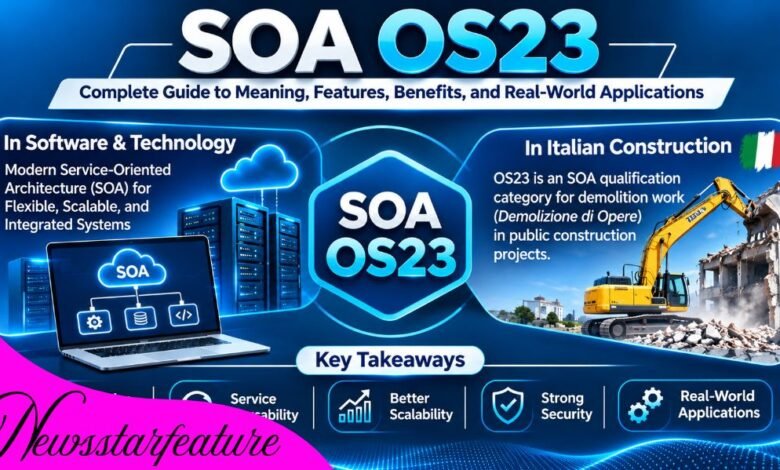
Introduction to SOA OS23
SOA OS23 has attracted attention across technology websites and professional discussions. Although the name sounds like a specialized operating system or newly released software platform, its meaning depends on the context.
In technology discussions, SOA OS23 is often presented as a modern interpretation of Service-Oriented Architecture, combining independent software services with cloud computing, APIs, automation, and flexible system integration.
However, SOA OS23 is not a verified, internationally recognized software standard. The term also has an established meaning in Italy’s construction industry, where OS23 identifies a category of specialized demolition work within the SOA qualification system.
Understanding these different uses helps readers separate established technical principles from potentially misleading descriptions.
What Is SOA OS23?
SOA OS23 can refer to two different subjects.
In software-related articles, it is an informal label associated with modern service-oriented architecture. This approach organizes complex applications into separate services that communicate through defined interfaces.
In Italian construction, SOA OS23 refers to the qualification category for demolition work, known as demolizione di opere. Contractors may need the appropriate SOA qualifications to participate in public construction tenders.
These meanings should not be confused. The construction category is formally established, whereas the software-related terminology does not have a clearly verified issuing standards organization.
SOA OS23 in Modern Software Architecture
Understanding Service-Oriented Architecture
Service-Oriented Architecture, commonly abbreviated as SOA, is a software design approach that divides business functions into reusable services.
Instead of constructing every function within one large application, developers create components responsible for specific activities.
For example, an online shopping platform might contain independent services for customer accounts, inventory management, payments, and order processing.
These services exchange information through agreed communication interfaces.
How the Modern Approach Works
The software interpretation of SOA OS23 generally combines established SOA principles with newer development practices.
Applications may use REST APIs, asynchronous messaging, containers, cloud infrastructure, and automated deployment pipelines.
Each technology serves a different purpose. APIs support communication, containers package applications, and monitoring systems help developers identify operational problems.
The central objective is to create manageable systems that can evolve without requiring developers to rebuild an entire application.
Core Technical Principles
Modular Design
Modularity lets developers separate business responsibilities into clear software components.
Service Reusability
Reusable services can support multiple applications, reducing unnecessary duplication.
Independent Communication
Clearly defined service contracts allow different applications and programming languages to communicate.
Security and Monitoring
Authentication, authorization, encryption, logging, and monitoring help protect distributed services and identify failures.
These are established architectural practices, not exclusive features of a verified product called SOA OS23.
Important Benefits of Service-Oriented Systems
Better Application Flexibility
Organizations can modify individual services without redesigning every connected application, as long as their interfaces remain compatible.
Improved System Integration
Service-based architecture can connect older enterprise applications with newer platforms, allowing organizations to modernize gradually.
Easier Maintenance
Separating responsibilities helps engineering teams locate problems and understand which components require attention.
Potential Scalability
Services can sometimes be scaled according to demand. However, performance improvements depend on system design, infrastructure, and operating conditions.
SOA does not automatically make an application faster or cheaper.
Real-World Applications
Banking and Financial Services
Banks use service-oriented approaches to connect customer information, transaction processing, authentication, and reporting systems.
Standardized interfaces can support integration between older financial software and modern digital banking applications.
E-Commerce Platforms
Online retailers can separate product catalogs, payment processing, stock availability, and delivery management.
This organization helps different teams maintain individual business functions.
Healthcare Technology
Healthcare organizations may use service interfaces to exchange authorized information between appointment systems, laboratory platforms, and administrative applications.
Appropriate privacy protections and regulatory compliance remain essential.
Enterprise Software
Large organizations use SOA principles to integrate customer relationship management, accounting, human resources, and inventory systems.
These are examples of service-oriented architecture generally, not verified deployments of a particular SOA OS23 product.
SOA OS23 in the Italian Construction Industry
What Does OS23 Mean?
OS23 is an Italian public works qualification category covering demolition work.
The abbreviation OS refers to Opere Specializzate, meaning specialized works.
Within Italy’s construction qualification framework, SOA attestation shows that a contractor meets the requirements for specific categories and classifications of public works.
Why Is This Qualification Important?
Demolition projects involve specialized equipment, technical expertise, site safety, and environmental responsibilities.
Public procurement authorities assess contractors against applicable qualification requirements when awarding relevant contracts.
An OS23 qualification identifies demolition-related construction capability. It does not represent a computer operating system, software version, or artificial intelligence platform.
How Can Contractors Obtain Qualification?
Businesses seeking appropriate SOA attestation generally work with an authorized certification body.
The evaluation considers applicable technical, organizational, and economic requirements, along with documented experience.
Qualification requirements vary by contract and relevant regulations. Contractors must also satisfy applicable safety and environmental obligations.
SOA OS23 vs Traditional SOA and Microservices
Traditional SOA emphasizes reusable business services and enterprise integration.
Microservices typically divide applications into smaller, independently deployable services with clearly defined responsibilities.
The informal software concept called SOA OS23 often combines ideas from both approaches.
However, no verified universal technical specification establishes what every SOA OS23 implementation must include.
Businesses should therefore evaluate specific architectural requirements rather than relying on an unfamiliar label.
Challenges and Considerations
Service-oriented systems introduce operational challenges alongside their advantages.
Communication between services can increase latency, distributed failures may complicate troubleshooting, and maintaining consistent data across applications requires careful planning.
Security responsibilities also expand when numerous services exchange sensitive information.
Effective architecture requires documentation, testing, version management, access controls, observability, and clearly assigned service ownership.
Adopting numerous services without a genuine business need can create unnecessary complexity.
Is SOA OS23 an Official Software Standard?
No authoritative publication establishing SOA OS23 as a formally recognized software standard could be verified.
Established organizations, including OASIS, document recognized Service-Oriented Architecture concepts and reference models.
Some websites expand SOA OS23 as “Service-Oriented Architecture Open Standard 2023,” but that expansion should not be presented as an officially confirmed standard.
Similarly, claims about an SOA OS23 operating system, an official release date, a proprietary AI engine, or a downloadable platform require independent verification.
Conclusion
SOA OS23 has two distinct meanings. In technology content, it commonly describes modern service-oriented architecture, although it is not a verified formal software standard. In Italy, OS23 is an established qualification category associated with demolition work.
For software professionals, the most valuable lessons involve modular development, integration, security, and responsible system management. For construction businesses, understanding the relevant SOA qualification requirements is essential.
Recognizing the distinction provides a clearer, more reliable understanding of SOA OS23.
(FAQs)
What is SOA OS23 used for?
In technology discussions, it informally describes modern service-oriented software design. In Italian construction, OS23 identifies specialized demolition work within the SOA qualification framework.
Is SOA OS23 an operating system?
There is no reliable verification that SOA OS23 is a standalone operating system comparable to Windows or Linux.
What are the main benefits of modern SOA?
Potential benefits include software reusability, easier integration, organizational flexibility, and more manageable application development.
Is SOA OS23 the same as microservices?
No. Microservices are an established architectural approach. SOA OS23 is an ambiguous term sometimes used to discuss similar modern software principles.
Is SOA OS23 certification necessary in Italy?
Relevant SOA qualification may be required for particular Italian public demolition contracts, depending on the project value, tender requirements, and applicable legislation.