barbeglue: The Ultimate Guide to BBQ Adhesive, Uses, Benefits, and Safe Application
Discover how barbeglue works, why it matters for outdoor barbecue construction, and how to use it correctly for reliable masonry joints.

Introduction
Building a durable outdoor barbecue requires more than quality bricks, concrete components, and an attractive design. The materials used to connect different sections also influence the structure’s stability and long-term performance. This is where barbeglue, a specialist adhesive associated with masonry barbecue assembly, becomes particularly useful.
Unlike ordinary household glue, barbeglue is designed to bond suitable construction materials in specific barbecue installations. It is associated with Sarom, an Italian manufacturer known for prefabricated concrete barbecues and outdoor cooking structures.
Understanding its properties, application requirements, and temperature limitations helps homeowners avoid common construction mistakes.
This article explains what barbeglue is, how it works, its main benefits, proper application methods, and essential safety precautions. It also answers common questions about barbecue adhesive and maintenance.
What Is barbeglue?
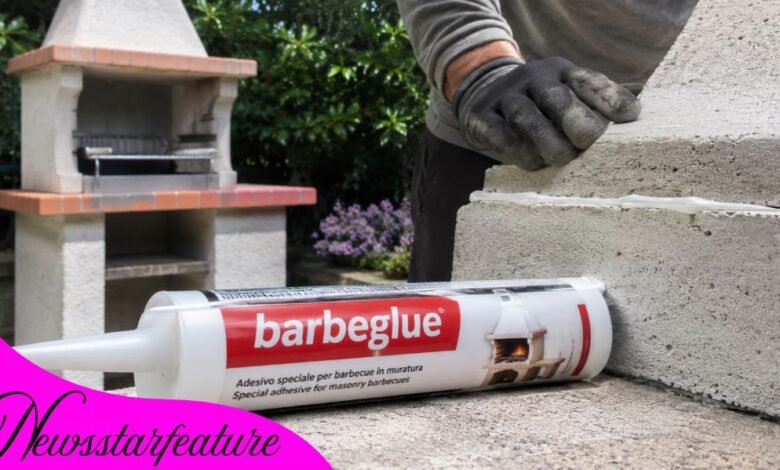
Barbeglue is a specialist adhesive used to join components of certain prefabricated masonry barbecues.
The product is associated with Sarom Fuoco, a brand offering outdoor cooking equipment, including concrete barbecues and masonry structures.
A manufacturer’s technical sheet identifies Barbeglue Isocoll ECO 6056 as a single-component, silyl-terminated polymer adhesive-sealant.
This formulation cures through contact with atmospheric moisture, creating an elastic bond between compatible surfaces.
Why Is Barbeglue Different From Ordinary Glue?
Standard household adhesives are not necessarily suitable for outdoor construction.
Barbeglue offers several characteristics relevant to its intended applications, including:
- Elasticity after curing.
- Resistance to outdoor weathering.
- Compatibility with suitable masonry materials.
- Paintability after curing.
- Convenient cartridge application.
However, these properties do not mean the product can withstand direct flames or unlimited temperatures.
Its suitability depends on correct placement and the barbecue manufacturer’s assembly instructions.
How Does Barbeglue Work?
Barbeglue works through a moisture-curing process.
When the adhesive leaves its cartridge, atmospheric moisture initiates a chemical reaction that gradually transforms the paste into an elastic bonding material.
The Bonding Process Explained
The adhesive is applied between prepared surfaces. As it cures, it gains mechanical strength while retaining flexibility.
This flexibility is useful where construction materials experience small movements caused by environmental changes.
Concrete and metal components can expand and contract at different rates. A suitable elastic joint can accommodate limited movement without behaving like a completely rigid connection.
Important Technical Characteristics
The Barbeglue Isocoll ECO 6056 technical sheet provides the following information:
Property Technical Information
Product type Polymer adhesive-sealant
Appearance White or grey paste
Tack-free time Approximately 30 minutes
Curing rate Approximately 3 mm per 24 hours
Application temperature 5°C to 50°C
Cured temperature resistance -40°C to 100°C
Standard cartridge 290 ml
These figures describe the documented formulation under specified conditions. Different products or packaging versions may have different specifications.
Main Benefits of Using Barbeglue
1. Flexible Bonding Performance
One important advantage is its ability to remain elastic after curing.
Outdoor construction materials naturally move with environmental changes. Flexible adhesive joints can accommodate limited changes better than some completely rigid bonding systems.
2. Outdoor Weather Resistance
Garden barbecues face changing temperatures, sunlight, humidity, and seasonal weather.
The documented formulation provides good weathering and ultraviolet resistance, making these properties relevant to exposed applications.
However, the barbecue structure may still require suitable exterior protection.
3. Easy Application
Barbeglue can be applied using an appropriate cartridge gun.
Its ready-to-use formulation eliminates the need to mix separate adhesive components before application.
4. Compatibility With Different Materials
The technical documentation identifies compatibility with various substrates, including brick, cement, stone, metal, and other construction materials.
Nevertheless, material compatibility should always be checked before assembly.
How to Apply Barbeglue Correctly
Correct application is essential for achieving a dependable bond.
Step 1: Prepare the Surface
Remove dust, grease, dirt, loose particles, and unwanted moisture.
Clean bonding surfaces help the adhesive make proper contact with the materials.
Step 2: Check the Construction Base
Before assembling a masonry barbecue, ensure its foundation is solid, appropriately sized, and level.
An uneven foundation can create unnecessary stress between heavy concrete sections.
Step 3: Apply the Adhesive
Using a suitable application gun, distribute the adhesive according to the assembly instructions.
Where specified, apply it to both joining surfaces.
Step 4: Position the Components
Carefully align the barbecue sections and check their position with a spirit level.
Follow the manufacturer’s recommended construction sequence rather than assembling components randomly.
Step 5: Allow Proper Curing
Sarom’s barbecue instructions specify waiting at least 48 hours before first use.
The actual adhesive curing process also depends on joint thickness, temperature, and humidity.
Safety Precautions During Application
Work in a suitable environment, follow the product safety information, and avoid direct contact with uncured adhesive.
Never apply the product to a burning or dangerously hot barbecue.
Can barbeglue Withstand High Temperatures?
Temperature resistance deserves particular attention.
Although barbeglue is associated with barbecue construction, the documented Isocoll ECO 6056 formulation has a published cured temperature resistance of up to 100°C.
A barbecue’s internal firebox can become significantly hotter.
Therefore, the product should not automatically be considered suitable for direct flame exposure or extremely hot cooking surfaces.
Sarom’s assembly guidance identifies both Barbeglue and appropriate refractory mortar for specified construction joints.
The right material depends on the barbecue model and the joint location.
Barbeglue vs Refractory Mortar
Both materials can play a role in masonry barbecue assembly, but they are not interchangeable in every situation.
| Feature | barbeglue | Refractory Mortar |
|---|---|---|
| Material | Polymer adhesive | Heat-resistant masonry mixture |
| Flexibility | Remains elastic | Generally forms a rigid joint |
| Application | Cartridge gun | Mortar application tools |
| Main purpose | Specified bonding joints | Suitable heat-exposed masonry joints |
| Selection | Follow product manual | Follow refractory specifications |
Do not substitute ordinary silicone sealant for Barbeglue when the barbecue instructions specifically prohibit it.
Common Mistakes to Avoid
Using an Incorrect Adhesive
Not every construction adhesive suits masonry barbecue assembly.
Always check the original assembly instructions before choosing an alternative.
Ignoring Surface Preparation
Dirty or poorly prepared surfaces can reduce bonding effectiveness.
Lighting the Barbecue Too Early
Heating too early can interfere with proper assembly and increase the risk of damage.
Applying Adhesive Directly to Fire-Exposed Surfaces
Never assume that an outdoor adhesive is automatically fireproof.
Always respect the manufacturer’s temperature limitations.
How to Maintain a Barbecue Assembled With Barbecue Glue
Regular maintenance helps protect outdoor masonry barbecue structures.
Periodically inspect visible joints for separation, movement, or deterioration.
Keep the structure clean and protect suitable exterior surfaces with the recommended weather-resistant coating.
Avoid sudden excessive heating and follow the manufacturer’s instructions for fuel quantities.
During prolonged periods of non-use, an appropriate protective cover can help reduce exposure to rain and harsh weather.
If substantial cracks or structural movement appear, stop using the barbecue until its condition has been assessed.
Conclusion
Barbeglue plays a useful role in assembling certain prefabricated masonry barbecues. Its flexible bonding, weather resistance, and ease of application make it suitable for designated construction joints.
However, proper surface preparation, correct material selection, and respect for temperature limitations are essential.
By following the manufacturer’s assembly instructions and maintaining the barbecue regularly, homeowners can create a more reliable outdoor cooking structure while reducing avoidable installation problems.
(FAQs)
What is barbeglue mainly used for?
Barbeglue is primarily used to join specified components of prefabricated masonry barbecues, particularly those manufactured by Sarom.
Is barbeglue waterproof?
The documented formulation offers strong weathering resistance. However, that does not mean every bonded joint is automatically waterproof under all conditions.
How long does barbeglue take to dry?
The Isocoll ECO 6056 technical sheet reports approximately 30 minutes to become tack-free under specified conditions. Sarom’s assembly instructions require at least 48 hours before using the completed barbecue.
Can barbeglue repair a cracked barbecue?
It may be suitable for certain compatible joints, but structural cracks and areas exposed directly to intense heat require assessment and manufacturer-approved repair materials.
Can ordinary silicone replace barbeglue?
No. Sarom’s barbecue assembly instructions explicitly warn against using ordinary silicone adhesive as a substitute.
Is barbeglue suitable for outdoor use?
Yes, its documented weather-resistant properties support suitable outdoor applications when it is used according to the manufacturer’s guidance.