icpfit: false – What It Means, Why It Appears, and How to Handle It Correctly
Understanding the ICP Fit Status in CRM Systems, APIs, Lead Scoring, and Business Data

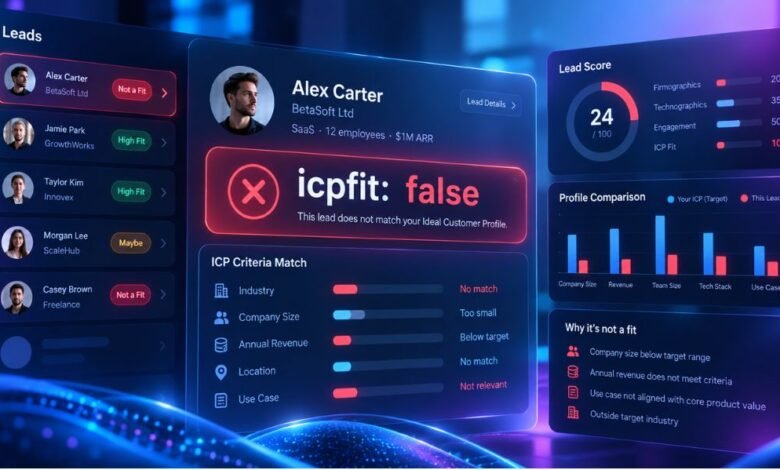
The expression icpfit: false may look like a small technical value, but it can carry important meaning inside CRM systems, sales platforms, APIs, automation tools, and lead-scoring applications. In most contexts, “ICP” refers to an Ideal Customer Profile, while “fit” describes whether a company, prospect, account, or opportunity matches the characteristics a business considers suitable.
When a system displays icpfit: false, it generally indicates that the evaluated record has not been identified as matching the defined Ideal Customer Profile. However, developers and business users should not automatically assume that “false” means the lead is worthless, rejected, or permanently disqualified. Its exact meaning depends on how the software implements the field.
Understanding this distinction is important because ICP information may influence lead qualification, sales prioritization, account segmentation, automated workflows, and marketing decisions.
What Does icpfit: false Mean?
The simplest interpretation of icpfit: false is that an ICP-fit condition has evaluated to a negative Boolean value.
In programming and structured data, a Boolean generally has two possible states: true or false. Therefore, a system using an icpFit Boolean field may use true when a record meets its ICP criteria and false when it does not.
However, the exact business meaning depends on the application.
For example, one company might consider employee count, location, industry, annual revenue, and technology stack when calculating ICP fit. Another may evaluate company size, buying authority, available budget, and customer needs.
Understanding the Ideal Customer Profile
An Ideal Customer Profile, commonly shortened to ICP, describes the type of customer that is particularly suitable for a company’s product or service.
An ICP may include characteristics such as:
- Industry
- Company size
- Geographic market
- Revenue range
- Business model
- Technology requirements
- Customer problems
- Purchasing capability
If a prospect fails to satisfy enough of these conditions, an automated system could potentially return icpfit: false.
Why ICP Fit Matters
ICP qualification helps businesses avoid treating every prospect in the same way. A company may have thousands of leads, but only a portion of them may closely match the audience its product was designed to serve.
By separating stronger and weaker matches, businesses can use their sales and marketing resources more efficiently.
Why Does icpfit: false Appear?
There are several possible reasons why icpfit: false may appear in a database, API response, CRM record, or automated workflow.
The Prospect Does Not Match Defined Criteria
The most straightforward explanation is that the company or prospect doesn’t meet the criteria the organization set.
For example, imagine that a software business primarily serves companies with 50 to 500 employees. A company with only three employees might fail the size requirement and receive a negative ICP-fit status.
Required Information May Be Missing
A negative value doesn’t always prove a prospect is unsuitable.
Some applications depend on information such as company size, industry, location, or revenue. If essential information is unavailable, the system may behave differently depending on how it’s programmed.
One platform may return false, another may return null, while another could use a separate value such as unknown or not set.
False and Missing Data Are Not Always the Same
This distinction deserves attention.
False normally represents an explicit negative state, while null, empty, unknown, or not-set values may mean the system lacks enough information to make a decision.
Developers should therefore review the relevant schema or application documentation before treating every negative-looking value as a confirmed rejection.
Is icpfit: false an Error?
In many cases, icpfit: false is not an error at all.
It may simply be a normal result produced by the system’s qualification logic.
For example:
icpFit: true
could indicate a matching customer profile, while:
icpFit: false
could indicate a non-matching profile.
A technical error would normally involve another problem, such as an invalid data type, a missing required property, an incorrect field name, a malformed request, failed validation, or an unsupported value.
When It Could Indicate a Configuration Problem
Although the value itself may be valid, unexpected results can point toward configuration problems.
If businesses notice that highly relevant prospects repeatedly receive icpfit: false, they should examine the criteria used to determine ICP fit.
Possible problems include outdated qualification rules, incorrectly mapped fields, missing CRM data, overly restrictive conditions, or an integration that is sending incomplete information.
How to Check an icpfit: false Result
Users should avoid manually changing the value until they understand why it was produced.
Review the ICP Criteria
Start by examining the requirements used by the system.
Check whether the record matches important conditions such as:
- Target industry
- Minimum company size
- Supported region
- Revenue requirements
- Customer type
- Business needs
This can reveal whether the negative Result is expected.
Inspect the Source Data
Next, verify the underlying information.
A CRM may contain incomplete or outdated company information. If the qualification system relies on incorrect data, the final ICP result can also become unreliable.
Check Field Names and Data Types
Developers working with an API should also verify the expected schema.
icpFit, icpfit, and ICPFit may not always be treated as identical field names. Many programming environments and APIs are case-sensitive.
Likewise, Boolean false should not automatically be confused with the string “false”.
Boolean False Versus String False
These two values can look similar to humans but represent different data types:
false
is normally a Boolean value.
“false”
is normally a text string.
Sending one when the system expects the other can cause validation problems or unexpected application behavior.
icpfit: false in Lead Qualification
Modern sales workflows often combine ICP fit with additional signals rather than relying on a single field.
A prospect may have weak ICP fit but demonstrate strong purchasing intent. Another company might closely match the Ideal Customer Profile but show no current interest in buying.
For this reason, ICP fit should generally be considered one qualification signal rather than the complete sales decision.
ICP Fit and Lead Scoring
Lead-scoring systems may combine several factors, including company fit, engagement, intent, demographics, and behavior.
This produces a more useful picture than simply dividing every prospect into good or bad categories.
A negative ICP-fit result can therefore help prioritize records without necessarily deleting or permanently rejecting them.
How Businesses Can Use ICP Fit More Effectively
A useful ICP model should reflect real customer patterns, not assumptions.
Businesses can improve their qualification process by reviewing successful customers and identifying characteristics they commonly share. Sales teams can then compare those characteristics with the rules their CRM or automation platform currently uses.
Keep Qualification Rules Updated
Markets change, products evolve, and businesses enter new industries. An ICP that worked two years ago may no longer represent the company’s strongest opportunities.
Regularly reviewing qualification criteria helps prevent potentially valuable leads from being misclassified.
Combine Automation With Human Review
Automation is useful for processing large amounts of information, but unusual or strategically important prospects may require manual evaluation.
A salesperson can sometimes identify context that an automated rule cannot recognize.
Conclusion
icpfit: false is most commonly associated with an Ideal Customer Profile qualification result in CRM, sales, API, and lead-management environments. It generally indicates that a prospect, company, or record has not satisfied the conditions required to be considered an ICP match.
However, always interpret the value in the context of the specific platform. Different applications can use Boolean values, categories, scores, or unknown states to represent customer fit.
Understanding the difference between false, missing data, incorrect configuration, and genuine disqualification is therefore essential. By reviewing ICP rules, checking source data, validating field types, and combining automated scoring with broader business signals, organizations can use ICP-fit information more accurately and make better qualification decisions.
(FAQs)
What does icpfit: false Mean?
It commonly means that a record has not been identified as matching the system’s defined Ideal Customer Profile. The exact interpretation depends on the software or API using the field.
Is icpfit: false an error?
Not necessarily. In many systems, it is simply a valid Boolean result. It becomes a concern when the value is unexpected or contradicts the intended qualification rules.
Does false mean a lead should be deleted?
No. A negative ICP-fit result does not automatically mean a lead has no value. Businesses may use additional factors such as buying intent, engagement, timing, or strategic importance.
Can missing data cause an incorrect ICP result?
Potentially, yes. If a system relies on incomplete company information, its qualification result may be less reliable. The exact behavior depends on the application.
Can I change icpfit from false to true?
Technically, some systems may allow you to change the field, but you shouldn’t change it to override an unwanted result. Check the underlying criteria and source data first.