Aicot: How Practical AI Solutions Are Helping Businesses Work Smarter
A closer look at Aicot, its approach to artificial intelligence, business automation, AI consulting, workflow improvement, and practical digital transformation.

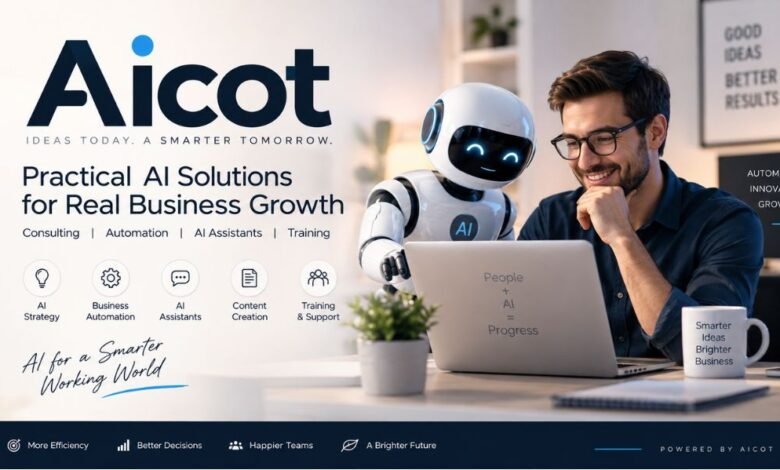
Artificial intelligence is no longer limited to global technology companies or specialist research laboratories. Small businesses, independent professionals, service providers, and growing companies are increasingly looking for practical ways to use AI in everyday operations. Aicot operates within this expanding field by focusing on artificial intelligence, automation, digital workflows, and business-focused AI solutions.
Instead of treating AI as a complicated technical subject, Aicot’s approach is centered on making the technology understandable and useful. Companies may want to automate repetitive work, improve internal knowledge management, build digital assistants, produce content more efficiently, or understand how AI fits into their existing processes.
As interest in AI consulting, business automation, generative AI, and intelligent workflows continues to grow, services like those offered by Aicot show how artificial intelligence can move from experimentation to practical business use.
What Is Aicot?
Aicot is an AI-focused consultancy and technology service provider that helps businesses understand and implement artificial intelligence in practical situations. Its services are especially relevant to small and medium-sized organizations, independent professionals, and businesses that may not have large in-house technology departments.
The central idea is relatively simple: a business should not adopt AI merely because the technology is popular. It should first identify a real operational problem and then determine whether AI can solve it efficiently.
The Main Purpose of Aicot
Aicot helps companies identify areas where artificial intelligence and automation can save time, simplify tasks, or improve productivity.
Businesses often hear about tools such as ChatGPT, AI assistants, automated customer support, machine learning, and generative AI. However, it can be hard to know which technology is genuinely useful.
A structured AI consultancy can help connect those technologies with real business requirements.
Turning AI Ideas Into Practical Applications
For example, a business might spend several hours every week answering similar customer questions. Another company may repeatedly create documents from the same information. A service provider may have valuable internal knowledge that employees struggle to locate quickly.
AI-powered assistants, automation systems, structured knowledge bases, or intelligent workflows can improve these situations.
How Aicot Approaches Business Automation
Automation is one of the most important areas within modern artificial intelligence.
Traditional automation normally follows fixed instructions. Modern AI-powered automation can handle more complex information, understand natural language, summarize documents, classify content, and support decision-making.
Aicot’s broader approach reflects this shift toward intelligent business processes.
Identifying Repetitive Tasks
Before introducing automation, businesses need to understand where employees are spending unnecessary time.
Typical examples may include:
- Preparing routine documents
- Organizing information
- Responding to common questions
- Creating basic content
- Processing internal requests
- Searching through company knowledge
- Moving information between different systems
The goal isn’t to automate everything. Successful automation usually focuses on tasks where technology can deliver measurable benefits without adding unnecessary complexity.
AI Assistants and Knowledge Systems
One increasingly popular use of artificial intelligence is developing specialized AI assistants.
Unlike a general chatbot, a business-focused assistant can be designed around specific organizational information and processes.
Supporting Employees With Faster Information
Imagine an employee who needs information from dozens of company documents. Searching manually may take considerable time.
An AI-supported knowledge assistant could help users find relevant information faster by letting them ask questions in natural language.
Such systems can be particularly valuable when businesses have large collections of procedures, instructions, policies, product information, or internal documentation.
Aicot and AI Strategy
One of the biggest mistakes organizations can make is purchasing AI software before understanding what they actually need.
A clear AI strategy starts with business objectives, not technology.
Why AI Strategy Matters
Businesses should consider questions such as:
What problems should AI solve?
Which tasks currently consume the most time?
What information will the system use?
Who will supervise automated outputs?
What privacy or security requirements exist?
How will success be measured?
Answering these questions can prevent organizations from spending money on technology that delivers little practical value.
Starting With Small, Measurable Projects
For many smaller businesses, a limited AI project can be more useful than a major transformation program.
A company might begin by automating one administrative workflow or creating one internal AI assistant. Once the organization understands the benefits and limitations, it can gradually introduce additional systems.
This approach reduces complexity while allowing employees to learn how AI fits into their daily work.
AI Training and Employee Education
Technology alone does not determine whether an AI project succeeds.
Employees also need to understand how to use artificial intelligence responsibly.
Understanding AI Limitations
Modern AI systems can produce impressive results, but they can also generate inaccurate or misleading information.
Users therefore need to understand concepts such as AI hallucinations, data privacy, bias, prompt design, security risks, and the need for responsible human review.
Training becomes particularly important when AI is used for customer communication, business documents, research, or decisions involving sensitive information.
Responsible AI Use
Businesses operating in Europe must also pay attention to privacy requirements and evolving artificial intelligence regulations.
Responsible implementation means considering how businesses collect, process, store, and use information.
Human Oversight Remains Important
Artificial intelligence can support employees, but businesses should not assume every automated result is correct.
Important outputs should still receive appropriate human review.
AI works best when it improves human productivity rather than removing sensible supervision.
AI-Powered Content Creation
Another area associated with modern AI services is content production.
Generative AI can assist businesses with blog articles, social media posts, images, marketing ideas, summaries, and internal documents.
AI Should Support Quality, Not Replace It
Generating large amounts of content is easy. Producing useful and accurate content is considerably harder.
Businesses should therefore use AI as part of a controlled editorial process.
Human review is essential for checking accuracy, tone, originality, brand consistency, and usefulness.
Creating Consistent Business Communication
When used carefully, AI can help maintain a consistent communication style across different formats.
Companies can develop structured guidelines covering terminology, tone, preferred wording, and brand identity. AI systems can then use those guidelines to support employees creating everyday business materials.
Who Could Benefit From Aicot?
Aicot’s practical approach may suit several types of organizations.
Small and medium-sized businesses can use AI to reduce administrative workload. Independent professionals may use automation to organize repetitive tasks. Trade businesses can explore digital processes without maintaining large IT departments.
Service companies may also benefit from AI-powered knowledge management, content production, customer communication, and internal workflow automation.
The important factor is not company size. It is whether a clear business problem exists that technology can reasonably improve.
The Future of Practical Business AI
Artificial intelligence is gradually becoming part of standard business software.
Companies are moving beyond simply experimenting with public AI chatbots. The next stage involves integrating AI into real workflows, internal knowledge systems, communication processes, and administrative operations.
From Experimentation to Integration
Businesses that gain the most value from AI are likely to be those that connect the technology to specific operational goals.
Instead of asking, “How can we use AI?” a more productive question is, “Which business problem should we solve?”
A Human-Centered Approach
Even as automation improves, human judgment remains essential.
Artificial intelligence can accelerate research, generate drafts, organize information, and automate routine work. People still provide context, accountability, creativity, experience, and final decision-making.
This balance between technology and human expertise is likely to define successful AI adoption.
(FAQs)
What is Aicot?
Aicot is an AI-focused consultancy and technology service that helps businesses explore practical applications of artificial intelligence, automation, AI assistants, content creation, and digital workflows.
What type of businesses can use Aicot services?
Its approach is particularly relevant to small and medium-sized businesses, independent professionals, service providers, and organizations seeking practical AI implementation.
Does Aicot only provide AI automation?
No. AI-related consulting can also include strategy development, training, intelligent assistants, knowledge systems, workflow optimization, and AI-supported content creation.
Why do businesses need an AI strategy?
An AI strategy helps organizations identify suitable use cases, control costs, understand risks, protect information, measure results, and avoid adopting technology without a clear purpose.
Can artificial intelligence completely replace employees?
AI can automate or accelerate certain tasks, but human oversight, expertise, judgment, and accountability remain important. The most practical approach is usually to use AI to support people and improve existing workflows.
Conclusion
Aicot represents a practical approach to the growing use of artificial intelligence in everyday business. Rather than viewing AI only as advanced technology, the focus is on applying it to real challenges such as repetitive work, information management, business processes, employee training, content creation, and digital automation.
For businesses exploring artificial intelligence, the most valuable lesson is to begin with a genuine need. Effective AI adoption requires clear objectives, appropriate technology, responsible data practices, employee understanding, and continued human oversight.
As AI becomes more accessible, organizations of different sizes will have increasing opportunities to use intelligent tools. Services such as Aicot demonstrate how the conversation around artificial intelligence is shifting from experimentation toward practical, measurable, business-focused implementation.