ARK Augmented Reality: How AI-Powered Technology Is Transforming Digital Experiences
Discover how ARK Augmented Reality combines artificial intelligence, contextual knowledge, and immersive technology to explore new possibilities for interactive digital environments.

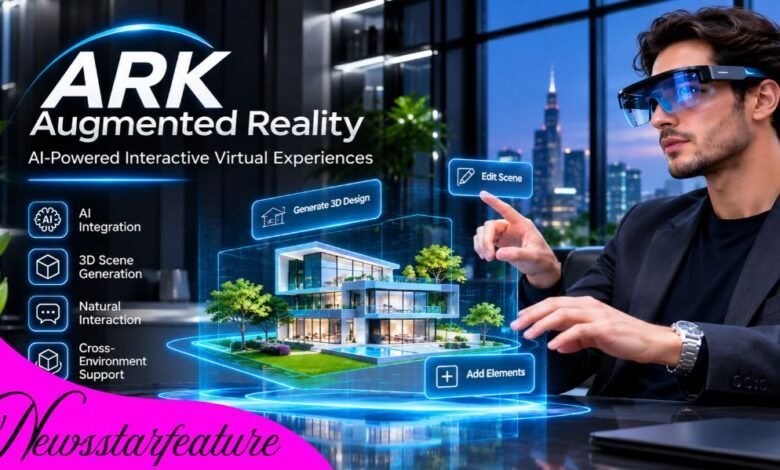
Introduction to ARK Augmented Reality
ARK Augmented Reality represents an innovative approach to connecting artificial intelligence with immersive digital environments. As augmented reality evolves, researchers are exploring systems that can understand surroundings, interpret information, and create realistic virtual experiences.
One important development is ArK, a research framework introduced in 2023 by researchers affiliated with Microsoft Research and academic institutions. Its research focuses on combining knowledge-based artificial intelligence with interactive scene generation.
Unlike conventional augmented reality applications that primarily place digital objects over real-world surroundings, ArK investigates how AI can use contextual knowledge to generate and modify digital environments.
Understanding this technology helps explain the growing relationship between augmented reality, generative AI, mixed reality, and spatial computing.
What Is ARK Augmented Reality?
ARK Augmented Reality commonly refers to a knowledge-driven approach to augmented reality associated with the ArK research framework.
The original research paper is titled ArK: Augmented Reality with Knowledge Interactive Emergent Ability. Within the research, the authors describe a mechanism called Augmented Reality with Knowledge Inference Interaction.
The central idea involves using information already learned by large AI models to support the understanding and creation of new digital scenes.
Rather than requiring extensive training data for every unfamiliar environment, this approach investigates how existing AI knowledge can be transferred to new situations.
Importantly, ArK is a research framework, not a verified standalone commercial augmented reality application.
How Does ARK Augmented Reality Work?
ARK Augmented Reality research combines several technologies to support intelligent scene understanding and generation.
Artificial Intelligence and Knowledge Integration
Artificial intelligence plays a central role in the ArK framework.
The research explores how foundation models, including language and image-generation systems, can contribute knowledge about objects, environments, and relationships.
For example, an AI system generating a virtual office could use contextual information to identify appropriate furniture, equipment, and spatial arrangements.
This process helps make generated environments more relevant to the user’s instructions.
Interactive Scene Generation
Traditional digital content creation often requires artists or developers to position and modify individual objects manually.
ArK explores a more interactive process in which users describe desired changes in natural language.
An AI-supported system can interpret those instructions and generate or edit elements of a virtual scene.
This offers a potential direction for more accessible digital environment creation.
The Role of Contextual Memory
Contextual memory is another important component.
Rather than treating each instruction independently, the research framework uses information from previous human-AI interactions to understand the intended scene better.
Remembering relevant instructions can help maintain consistency when users request additional changes.
Key Features of ARK Augmented Reality Research
Knowledge-Enhanced Understanding
The framework investigates how AI models can apply existing knowledge to unfamiliar scenarios.
This may reduce the dependence on collecting entirely new training datasets for every environment.
2D and 3D Content Generation
ArK research includes experiments involving both two-dimensional images and three-dimensional virtual scenes.
Its authors reported improvements in the relevance and naturalness of generated content when contextual knowledge was incorporated.
Conversational Interaction
The system explores how natural-language instructions can guide digital content generation and editing.
This approach could make complex creative workflows more approachable for users without extensive technical experience.
Cross-Environment Capabilities
Another research objective involves transferring knowledge between physical, virtual, and mixed-reality settings.
The ability to reuse contextual information across different environments is important for future immersive technology development.
Potential Applications of ARK Augmented Reality
Although ArK remains research-oriented, its underlying concepts suggest several possible applications.
Gaming and Interactive Entertainment
Game developers could potentially use knowledge-enhanced AI to create detailed environments through conversational instructions.
This might simplify certain aspects of scene design and enable more responsive virtual worlds.
Education and Virtual Learning
Educational environments could benefit from intelligent scene generation.
For example, teachers might eventually use similar systems to produce interactive historical settings, scientific demonstrations, or simulated learning environments.
These possibilities remain applications of the broader research concept, not verified commercial ArK services.
Architecture and Interior Design
Knowledge-driven scene generation could help designers explore different room layouts and visual concepts.
AI-generated environments might help users communicate ideas before preparing detailed professional designs.
Training and Simulation
Organizations could potentially use intelligent virtual environments to develop training scenarios.
Possible areas include equipment familiarization, workplace instruction, and simulated operational environments.
However, safety-critical uses would require extensive independent validation.
ARK Augmented Reality vs Traditional Augmented Reality
Understanding the difference between ArK and conventional augmented reality is essential.
FeatureTraditional ARArK Research
Primary purpose Overlay digital content Knowledge-enhanced scene generation
AI integration Depends on application Central research component
Contextual knowledge Varies by system Core research objective
Scene editing Application-dependent Explores conversational editing
Availability Commercial applications exist Research framework
Traditional augmented reality platforms already support interactive digital objects, environmental tracking, and spatial experiences.
ArK does not replace these technologies. Instead, its research explores how knowledge-based AI could improve the intelligence and flexibility of generated environments.
Benefits of Knowledge-Driven Augmented Reality
ArK’s broader approach offers several potential advantages.
Improved content relevance is particularly important. When AI understands contextual relationships, generated objects and environments may better match user instructions.
Another possible benefit is reduced manual effort. Conversational editing could simplify portions of the digital creation process.
Knowledge transfer may also help researchers investigate unfamiliar scenarios without building separate training datasets for every task.
These benefits are promising, but experimental findings should not be confused with guaranteed performance in commercial applications.
Challenges and Limitations
Despite its potential, ARK Augmented Reality research faces significant technical challenges.
AI Accuracy
Generative AI models can produce incorrect information or unrealistic objects.
Errors in contextual understanding may reduce the quality and reliability of generated scenes.
Computational Requirements
Advanced AI systems and immersive graphics can require substantial processing resources.
Delivering responsive experiences on consumer devices remains an important engineering challenge.
Privacy and Data Protection
Future context-aware AR applications may process information about physical surroundings and user interactions.
Appropriate privacy safeguards, user consent, and secure data handling would therefore be essential.
Research Versus Commercial Availability
The published ArK experiments demonstrate specific research capabilities, not a universally available consumer product.
Its reported results should not be interpreted as proof of successful deployment across every augmented reality application.
The Future of ARK Augmented Reality
The future of augmented reality increasingly involves connections between artificial intelligence, spatial computing, and interactive digital content.
Research such as ArK highlights an important direction: moving beyond simple visual overlays toward systems that can interpret instructions, reuse knowledge, and generate meaningful environments.
Future developments could make immersive content creation more flexible and accessible.
However, wider adoption will depend on improvements in accuracy, computational efficiency, privacy protections, and practical validation.
Frequently Asked Questions
What is ARK Augmented Reality?
ARK Augmented Reality can refer to the ArK research framework, which explores using artificial intelligence and contextual knowledge to improve digital scene understanding and generation.
Is ARK Augmented Reality a mobile application?
The Microsoft Research ArK framework is not a verified standalone consumer mobile application. It is primarily documented through technical research.
How is ArK different from ARKit?
ArK is an AI research framework focused on knowledge-driven scene generation. ARKit is Apple’s development framework for creating augmented reality applications.
Can ARK Augmented Reality improve gaming?
Its research suggests potential benefits for interactive scene creation and virtual environment editing, although commercial gaming performance has not been established.
Is ARK Augmented Reality the same as virtual reality?
No. Augmented reality generally combines digital elements with real-world surroundings, while virtual reality creates immersive virtual environments. ArK research investigates content generation across these settings.
Why is artificial intelligence important for ARK?
AI provides contextual knowledge, language understanding, and generative capabilities that help systems interpret instructions and create digital scenes.
Conclusion
ARK Augmented Reality highlights an emerging relationship between artificial intelligence and immersive digital experiences.
The ArK research framework shows how contextual knowledge and generative models can support more interactive scene creation and editing.
Although it is not a finished consumer platform, its concepts contribute to broader discussions about intelligent virtual environments, mixed reality, and future spatial computing applications.
Understanding the distinction between proven research results and potential commercial uses clarifies what this technology can realistically offer.