DAFO Analysis: A Powerful Guide to Smarter Business Decisions and Strategic Growth
Understanding Strengths, Weaknesses, Opportunities, and Threats for Effective Business Planning

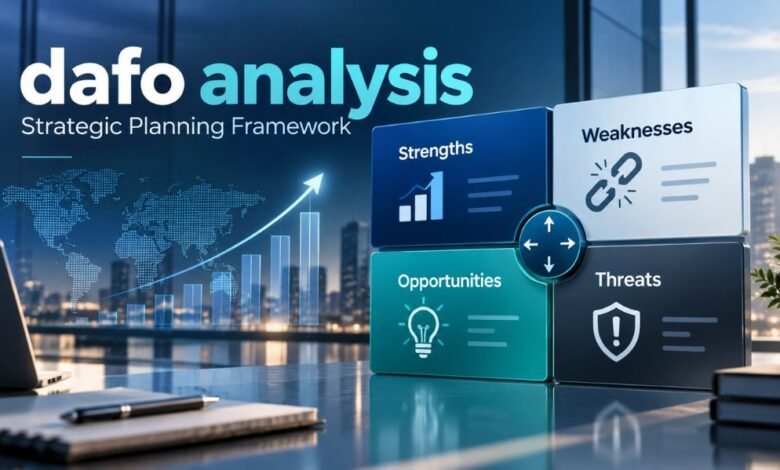
Every successful business needs a clear understanding of its current position, competitive advantages, and potential challenges. DAFO analysis is a practical strategic planning tool that helps organizations evaluate their internal capabilities and external business environment. By identifying strengths, weaknesses, opportunities, and threats, companies can make informed decisions and develop effective strategies for sustainable growth.
Whether you manage a small business, run a startup, or lead an established organization, DAFO analysis offers a structured way to understand market conditions and improve performance.
This article explains what DAFO analysis is, its components, benefits, and practical applications, including a step-by-step guide and business example.
What Is DAFO Analysis?
DAFO analysis is a strategic management framework that evaluates four key factors affecting a business or project. The acronym DAFO comes from the Spanish words Debilidades, Amenazas, Fortalezas, and Oportunidades.
In English, these represent:
- D – Debilidades: Weaknesses
- A – Amenazas: Threats
- F – Fortalezas: Strengths
- O – Oportunidades: Opportunities
The method is equivalent to SWOT analysis, a widely recognized business planning technique.
Its primary purpose is to help organizations understand their competitive position, identify potential risks, and discover opportunities for improvement.
Unlike complex forecasting models, DAFO analysis presents essential information in a simple four-part matrix that managers can use to make strategic decisions.
The Four Essential Components of DAFO Analysis
Understanding the four components is necessary for conducting an accurate business assessment.
1. Strengths: Internal Competitive Advantages
Strengths are internal characteristics that help an organization perform effectively or outperform competitors.
Examples include:
- Strong brand reputation and customer loyalty.
- Experienced employees and effective leadership.
- High-quality products and reliable services.
- Efficient business processes.
- Strong financial resources.
Identifying strengths helps organizations understand what they do well and how these advantages can support future growth.
2. Weaknesses: Internal Areas Requiring Improvement
Weaknesses are internal limitations that reduce efficiency, profitability, or competitiveness.
Common examples include insufficient marketing resources, outdated technology, poor communication, limited employee training, and inefficient operations.
A realistic assessment of weaknesses helps business leaders identify problems before they become serious obstacles.
Recognizing weaknesses is not a failure. Instead, it provides an opportunity for organizational improvement.
3. Opportunities: External Possibilities for Growth
Opportunities are favorable external circumstances that an organization may use to achieve its objectives.
These may include emerging markets, changing consumer preferences, technological developments, new partnerships, or increasing demand for particular products.
For example, a local retailer may find an opportunity to expand through e-commerce as more customers shop online.
Organizations that identify opportunities early can position themselves for long-term competitive advantages.
4. Threats: External Business Challenges
Threats are external factors that may negatively affect business performance.
Examples include increasing competition, economic uncertainty, changing regulations, supply chain disruptions, and rising operating expenses.
Although businesses cannot control every external threat, they can develop contingency plans and reduce their exposure to potential risks.
How to Conduct DAFO Analysis Step by Step
An effective DAFO analysis requires research, objective evaluation, and a clear understanding of business goals.
Step 1: Define Your Business Objectives
Begin by identifying the specific decision or challenge you want to address.
Your objective might involve entering a new market, launching a product, improving profitability, or strengthening customer retention.
A clearly defined objective keeps the analysis focused and relevant.
Step 2: Collect Relevant Information
Gather information from reliable business records, customer feedback, employee discussions, market research, and competitor assessments.
Use measurable evidence wherever possible. Financial reports, customer satisfaction scores, and sales trends can support more accurate conclusions.
Step 3: Identify Internal Factors
Examine your organization’s resources, capabilities, processes, and performance.
Separate positive internal factors into strengths and negative internal factors into weaknesses.
Step 4: Evaluate External Conditions
Study market developments, customer expectations, technological changes, competitors, and regulatory conditions.
Classify favorable external circumstances as opportunities and potentially harmful conditions as threats.
Step 5: Develop Your DAFO Matrix
Organize your findings into four categories.
Internal Factors External Factors
Strengths: Competitive advantages Opportunities: Growth possibilities
Weaknesses: Internal limitations Threats: External challenges
This matrix provides a clear overview of the organization’s strategic position.
Step 6: Convert Findings Into Actions
Create a Practical Strategic Action Plan
The most important stage involves translating findings into measurable actions.
Managers should prioritize important issues, assign responsibilities, establish deadlines, and monitor progress.
For example, a business experiencing weak online visibility might invest in website improvements and digital marketing to reach new customers.
Practical DAFO Analysis Example
Consider a fictional independent coffee shop operating in a competitive urban market.
Strengths
The coffee shop offers high-quality beverages, friendly customer service, and a loyal local customer base.
Weaknesses
Its weaknesses include limited seating, a small advertising budget, and an outdated ordering system.
Opportunities
Increasing demand for specialty coffee, local delivery partnerships, and online ordering services could create new revenue opportunities.
Threats
Potential threats include rising ingredient costs, new competitors, and reduced consumer spending.
Strategic Recommendations
Based on these findings, the coffee shop could introduce online ordering, strengthen its social media presence, and develop customer loyalty programs.
It could also negotiate with suppliers to manage operating expenses.
This example demonstrates how DAFO analysis for business planning can transform observations into practical decisions.
Major Benefits of DAFO Analysis
DAFO analysis offers several advantages for businesses of different sizes.
Better Strategic Decision-Making
By examining internal and external factors together, managers can make more balanced decisions instead of relying solely on assumptions.
Improved Risk Management
Identifying threats encourages organizations to develop preventive measures and prepare for unexpected challenges.
Stronger Competitive Positioning
Understanding competitive strengths helps organizations communicate their value and differentiate their products or services.
Efficient Resource Allocation
Businesses can direct time, financial resources, and employee efforts toward opportunities that offer meaningful potential benefits.
Greater Organizational Awareness
The process encourages cross-departmental discussions and helps employees understand shared business priorities.
Common Mistakes to Avoid
Although DAFO analysis is straightforward, inaccurate assessments can reduce its effectiveness.
Confusing Internal and External Factors
A weak marketing team is an internal weakness, while increasing advertising costs across an industry represent an external threat.
Keeping these factors separate is essential.
Relying on Personal Opinions
Unsupported assumptions can lead to misleading conclusions. Businesses should validate key findings with research and measurable data.
Listing Too Many Factors
An excessively long matrix can make strategic priorities difficult to identify. Focus on the factors with the greatest potential impact.
Ignoring Implementation
A DAFO matrix alone does not improve business performance. Organizations must convert observations into specific actions.
DAFO Analysis vs. SWOT Analysis
DAFO and SWOT analysis use the same fundamental strategic framework.
The primary difference is terminology.
DAFO is commonly used in Spain, while SWOT is the English-language acronym. FODA is another commonly used Spanish variation.
Both approaches examine internal strengths and weaknesses alongside external opportunities and threats.
Therefore, organizations can use either term without changing the fundamental analytical method.
How DAFO Analysis Supports Long-Term Business Growth
DAFO analysis becomes particularly valuable when organizations review it regularly.
Markets change, customer expectations evolve, and technologies create new competitive pressures.
A business that updates its analysis periodically can recognize emerging problems and adjust its strategy.
Combining DAFO with other planning tools, such as PESTEL analysis, can provide deeper insight into political, economic, social, technological, environmental, and legal influences.
Businesses can also use CAME analysis to turn findings into actions: Correct weaknesses, Address threats, Maintain strengths, and Exploit opportunities.
However, strategic success depends on implementation, monitoring, and continuous improvement, not analysis alone.
Conclusion
DAFO analysis is a valuable strategic planning method that helps organizations understand their capabilities, recognize limitations, identify growth opportunities, and prepare for external threats.
Its straightforward structure makes it useful for startups, established businesses, nonprofit organizations, and individual projects.
With reliable information and practical implementation, DAFO analysis can strengthen decision-making, improve resource management, and support sustainable organizational development.
Frequently Asked Questions
1. What does DAFO analysis mean?
DAFO analysis is a strategic planning method that evaluates strengths, weaknesses, opportunities, and threats. It helps businesses understand their internal capabilities and external environment.
2. What is the difference between DAFO and SWOT analysis?
Both methods use the same four strategic categories. DAFO is a Spanish-language acronym, while SWOT is the equivalent English acronym.
3. Why is DAFO analysis important for businesses?
It helps businesses identify competitive advantages, recognize weaknesses, understand market opportunities, manage risks, and make better strategic decisions.
4. Can small businesses use DAFO analysis?
Yes. Small businesses can use DAFO analysis to assess resources, evaluate competitors, identify growth opportunities, and develop realistic business plans without complicated analytical tools.
5. How often should a company conduct DAFO analysis?
Companies should review their DAFO analysis whenever significant business or market changes occur. Quarterly or annual reviews may be appropriate depending on the organization’s industry, size, and strategic objectives.