Research Dossier For Target Company: The Ultimate Guide to Strategic Business Research and Competitive Intelligence
A practical guide to researching a target company, evaluating its financial strength, understanding competitors, and making informed business decisions.

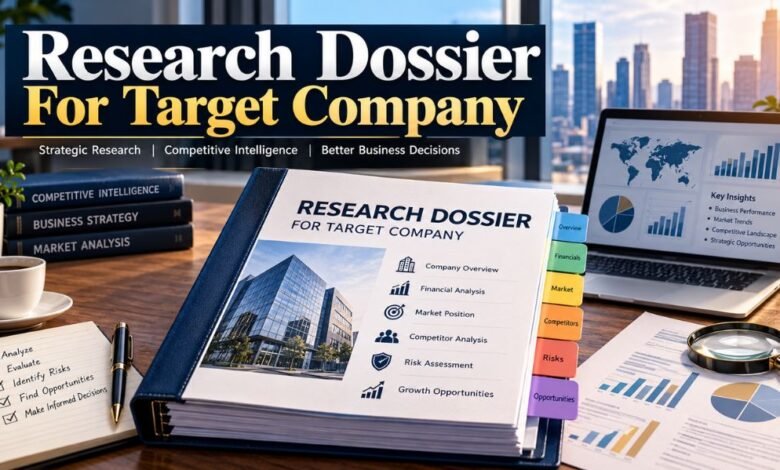
A Research Dossier For Target Company is a structured collection of information used to understand a business before making important decisions. Whether an organization is considering an investment, evaluating a potential partnership, preparing a sales strategy, or exploring an acquisition, a well-prepared research dossier offers valuable insights into the company’s operations, financial position, competitive environment, and future opportunities.
Business decisions are more reliable when supported by verified information rather than assumptions. A company may appear successful through its marketing, but deeper investigation could reveal operational challenges, financial uncertainty, or intense competitive pressure.
A professional company research dossier helps decision-makers understand a business’s strengths and weaknesses.
This article explains how to prepare a comprehensive target company research dossier, identify reliable information sources, evaluate business performance, and organize findings into actionable insights.
What Is a Research Dossier For Target Company?
A target company research dossier is a detailed business intelligence document that contains verified facts, observations, and analysis about a specific organization. It presents essential information in a logical format so that researchers, investors, executives, and business development teams can assess the company’s position.
Unlike a basic company profile, a dossier examines several dimensions of business performance. These may include corporate history, ownership, leadership, products, customers, market positioning, financial information, and potential business risks.
The depth of research depends on its intended purpose. An investment dossier generally emphasizes financial performance, valuation, and risk exposure, while a sales intelligence dossier focuses on customer needs, purchasing structures, and possible commercial opportunities.
A useful dossier should clearly distinguish confirmed facts, analytical interpretations, and unavailable information.
Why Target Company Research Matters
Researching a company before entering a business relationship helps organizations make decisions with greater confidence.
Supporting Strategic Business Decisions
Reliable corporate intelligence helps management teams assess whether a company aligns with their commercial objectives.
For example, a technology company considering a partnership with a software provider may investigate its product capabilities, customer base, security practices, and long-term business stability.
This information supports a more realistic assessment of the proposed relationship.
Identifying Business Risks
Every business faces financial, operational, regulatory, and competitive risks.
A target company dossier can reveal warning signs such as inconsistent financial reporting, significant customer concentration, leadership instability, or unresolved legal disputes.
However, these findings must be supported by credible evidence. Unverified allegations should never be presented as facts.
Discovering Growth Opportunities
Research also helps identify commercial opportunities, including underserved customer segments, potential partnerships, product expansion, and new geographic markets.
Understanding where a company currently operates can provide useful context for evaluating its future development.
Essential Components of a Target Company Research Dossier
A comprehensive dossier should contain several clearly organized sections.
Company Background and Corporate Profile
Begin with the company’s basic identity and history.
Important details include its registered business name, headquarters, founding date, industry classification, ownership structure, and primary business activities.
Researchers should distinguish between a company’s legal entity, trading names, subsidiaries, and parent organization.
Leadership and Corporate Governance
Examine the company’s executive leadership, board composition, and governance arrangements where reliable public information is available.
Leadership experience, organizational accountability, and management continuity can influence business stability.
Don’t assume an executive’s past achievements guarantee future performance.
Products, Services, and Business Model
Understanding how a company generates revenue is essential.
Identify its main products, services, customer segments, pricing approach, and distribution channels.
The business model may depend on subscriptions, direct sales, licensing, manufacturing, professional services, or a combination of revenue streams.
Researchers should determine which activities are publicly documented rather than estimating their financial contribution without supporting evidence.
Financial Performance and Stability
Financial analysis is an important part of company due diligence.
Relevant indicators include revenue, operating profit, net income, cash flow, debt obligations, and liquidity.
Evaluating Financial Information
Publicly listed companies often publish detailed financial statements, while private companies may disclose substantially less information.
When financial information is available, examine reporting periods, accounting standards, and whether figures have been independently audited.
Revenue growth does not automatically indicate profitability, and strong reported earnings do not necessarily mean a company has sufficient cash.
Financial conclusions should reflect these distinctions.
Competitive Intelligence and Market Position
A company’s performance becomes more meaningful when examined within its wider industry.
Competitive intelligence involves understanding how the target business compares with other organizations offering similar products or services.
Identifying Major Competitors
Researchers should identify direct competitors that serve similar customers and indirect competitors that offer alternative solutions.
Useful comparisons include product quality, pricing, distribution, market coverage, customer experience, and technological capabilities.
Understanding Market Trends
Industry developments can affect business prospects.
Regulatory changes, technological innovation, changing consumer preferences, and economic conditions may create opportunities or introduce challenges.
A reliable dossier separates documented industry developments from predictions about future market performance.
Conducting a SWOT Analysis
A SWOT analysis organizes important findings into four categories:
- Strengths: Internal capabilities that support competitive performance.
- Weaknesses: Internal limitations affecting business operations.
- Opportunities: External circumstances that may support development.
- Threats: External pressures that could negatively affect performance.
Each assessment should be connected to specific research findings rather than general assumptions.
How to Prepare a Research Dossier For Target Company
Creating an effective business research document requires a systematic process.
Step 1: Define the Research Objective
Identify the purpose of the dossier before collecting information.
Investment evaluation, supplier assessment, partnership development, and acquisition screening require different levels of analysis.
A clear objective prevents unnecessary research and improves the final document’s relevance.
Step 2: Collect Reliable Information
Prioritize credible primary sources, including official company disclosures, regulatory filings, audited financial statements, and documented corporate announcements.
Established industry research and reputable journalism can provide additional context.
Record the publication date and reporting period of important information to prevent outdated material from being mistaken for current facts.
Step 3: Verify Important Findings
Cross-check significant claims wherever possible.
Pay particular attention to company ownership, financial figures, legal developments, and executive appointments.
If sources disagree, document the discrepancy rather than selecting whichever figure appears most favorable.
Step 4: Analyze the Evidence
Organize verified information into meaningful categories.
Compare business performance against relevant competitors and industry conditions.
A professional researcher should explain what the evidence demonstrates, what remains uncertain, and why particular findings matter to the intended decision.
Step 5: Prepare the Final Report
Present the research through clearly labeled sections, concise explanations, and evidence-based conclusions.
Include an executive summary, company overview, financial analysis, competitive assessment, risk evaluation, and recommendations appropriate to the research objective.
A structured format makes the dossier easier to review and update.
Common Mistakes in Company Research
Even extensive research can produce misleading conclusions when the underlying approach is weak.
One common mistake is depending entirely on company marketing material. Promotional information may accurately describe products but isn’t enough to independently establish financial strength or market leadership.
Another mistake involves using outdated financial data without identifying its reporting period.
Researchers should also avoid presenting estimates as confirmed results, overlooking corporate subsidiaries, or confusing correlation with causation.
Research accuracy and transparency are more important than the volume of information collected.
Best Practices for Maintaining an Accurate Research Dossier
A research dossier should be treated as a document that requires periodic review.
Financial performance, executive leadership, ownership arrangements, and market conditions can change.
Record when you verified each major finding, and clearly distinguish historical information from current developments.
Sensitive personal information should not be collected unnecessarily. Researchers must respect applicable privacy requirements and obtain confidential business information only through lawful, authorized methods.
The strongest dossiers provide useful business intelligence without sacrificing accuracy, fairness, or responsible research practices.
Conclusion
A Research Dossier For Target Company provides a disciplined foundation for understanding an organization’s operations, financial condition, market position, and potential risks. Its value comes from combining reliable research with clear analysis rather than simply gathering large amounts of information.
By defining research objectives, verifying key facts, analyzing financial performance, examining competitors, and documenting uncertainties, businesses can develop a more balanced view of potential commercial relationships.
A well-prepared dossier supports strategic planning, investment evaluation, partnership assessment, and responsible corporate decision-making.
(FAQs)
1. What is the main purpose of a research dossier for a target company?
Its main purpose is to collect, verify, and analyze important business information so decision-makers can evaluate a company’s operations, financial condition, competitive position, and potential risks.
2. What information should a target company research dossier include?
A comprehensive dossier generally includes the company’s background, ownership, leadership, products, business model, financial information, competitors, industry conditions, and risk assessment.
3. How can researchers find reliable company information?
Researchers can use official company disclosures, regulatory filings, audited financial reports, corporate announcements, and reputable industry publications. Important findings should be independently verified where possible.
4. Is a company research dossier useful for small businesses?
Yes. Small businesses can use research dossiers to evaluate suppliers, understand competitors, identify partnership opportunities, and assess potential customers before committing resources.
5. How often should a target company research dossier be updated?
The right frequency depends on its intended use and how fast the industry changes. Review critical information before major decisions, especially when financial results, ownership, leadership, or regulatory circumstances have changed.